Squats without weights
Four leg moves that need only a chair and a wall: the box squat, the squat, the split squat and the wall sit.
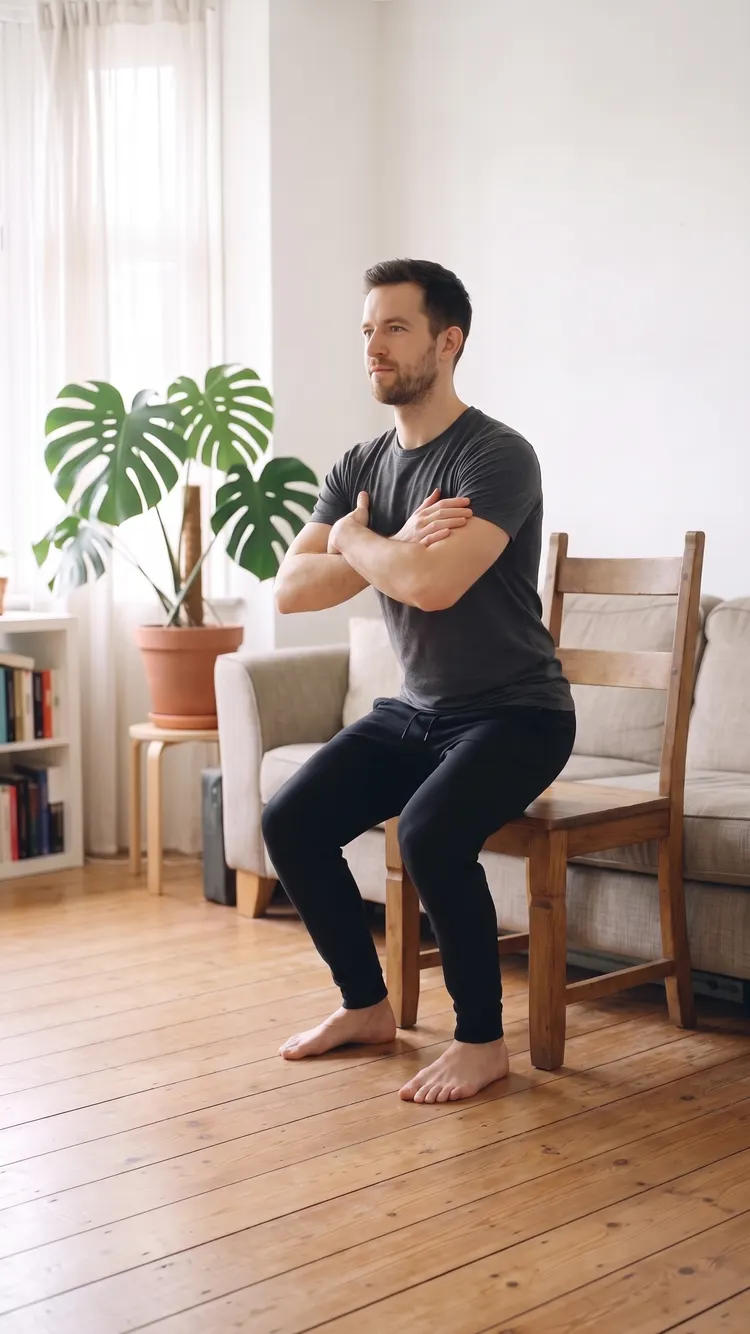
You do not need a barbell to train your legs. Your own bodyweight is plenty when you slow down. These four moves go from the most supported to the most demanding: a squat to a chair, a squat without one, a squat from a staggered stance, and a hold against a wall.
Depth is yours to choose. Go only as far as is comfortable, keep your knees tracking over your toes and your chest tall, and use the chair or wall for confidence. Slow lowering makes any of these harder without adding anything.
The moves, one by one
Start with the box squat and move down the list as each one feels easy.
Box squat
Sit back to a chair behind you and touch it lightly. The chair sets your depth.
- Set a sturdy chair with no wheels, its back against a wall. Stand in front of it with the backs of your legs near the seat, feet shoulder-width apart, toes turned out a little.
- Cross your arms on your chest, or hold them out in front for balance.
- Breathe in and send your hips back, then bend your knees, keeping your chest tall.
- Touch the seat lightly with your hips. Do not drop onto it.
- Breathe out, press through your whole foot and stand up. Repeat 6 times.
EasierUse a higher seat with a firm cushion that will not slide, or rest your hands on your thighs. Sit to stand is the step below.
Take care
- Knees: go down only as far as is comfortable. Beginners, stay at chair height or higher.
- Hips: keep your feet a little wider if your hips pinch at the bottom.
- Balance: keep the chair against the wall so it cannot slide. Stand up slowly.
Squat
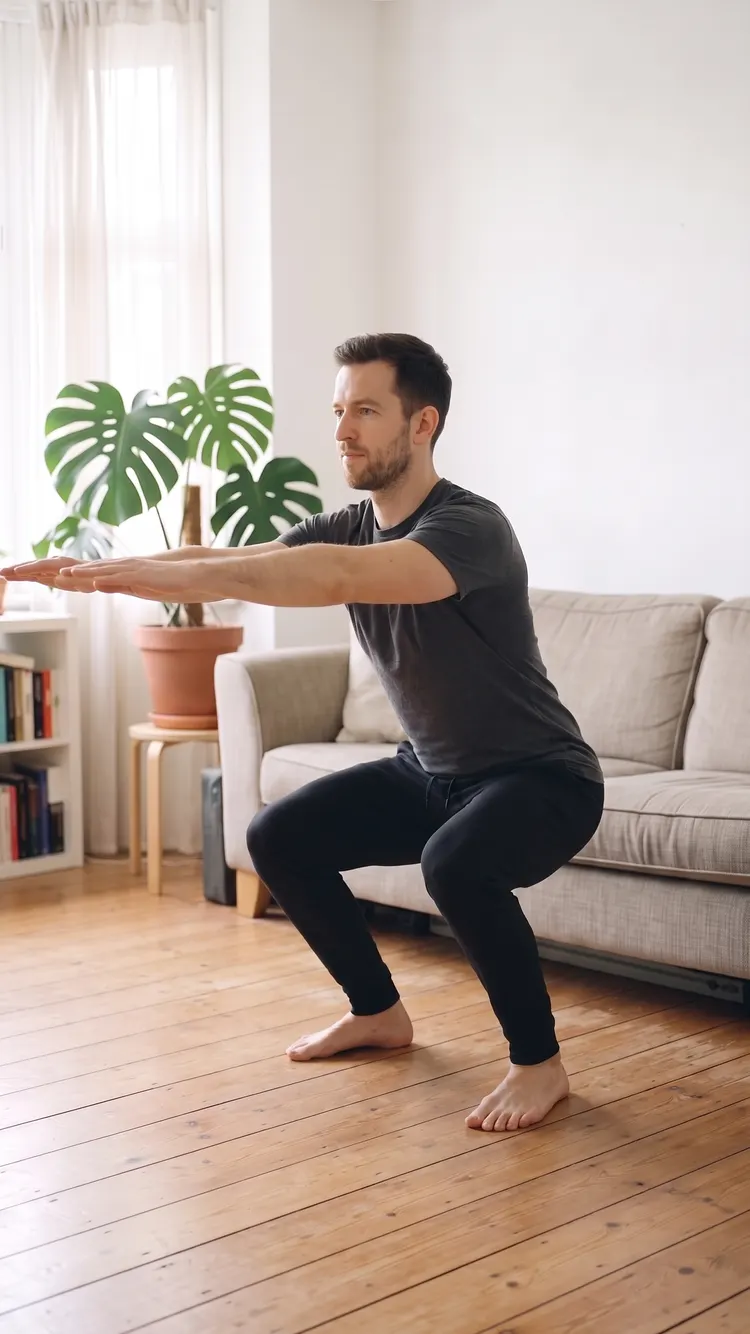
The same pattern with no chair. Hold a counter if you wobble.
- Stand with your feet shoulder-width apart, toes turned out a little.
- Hold your arms out in front of you, or cross them on your chest.
- Breathe in, send your hips back and bend your knees, keeping your chest tall.
- Lower as far as is comfortable, with your heels on the floor.
- Breathe out, press through your whole foot and stand. Repeat 10 times.
EasierSquat to a chair behind you (a box squat), or hold a counter in front of you.
Take care
- Knees: go down only as far as is comfortable. Beginners, stop at chair height.
- Back: keep your chest tall and your back long. Do not round forward.
- Balance: if you wobble, hold a counter or wall with one hand.
Split squat
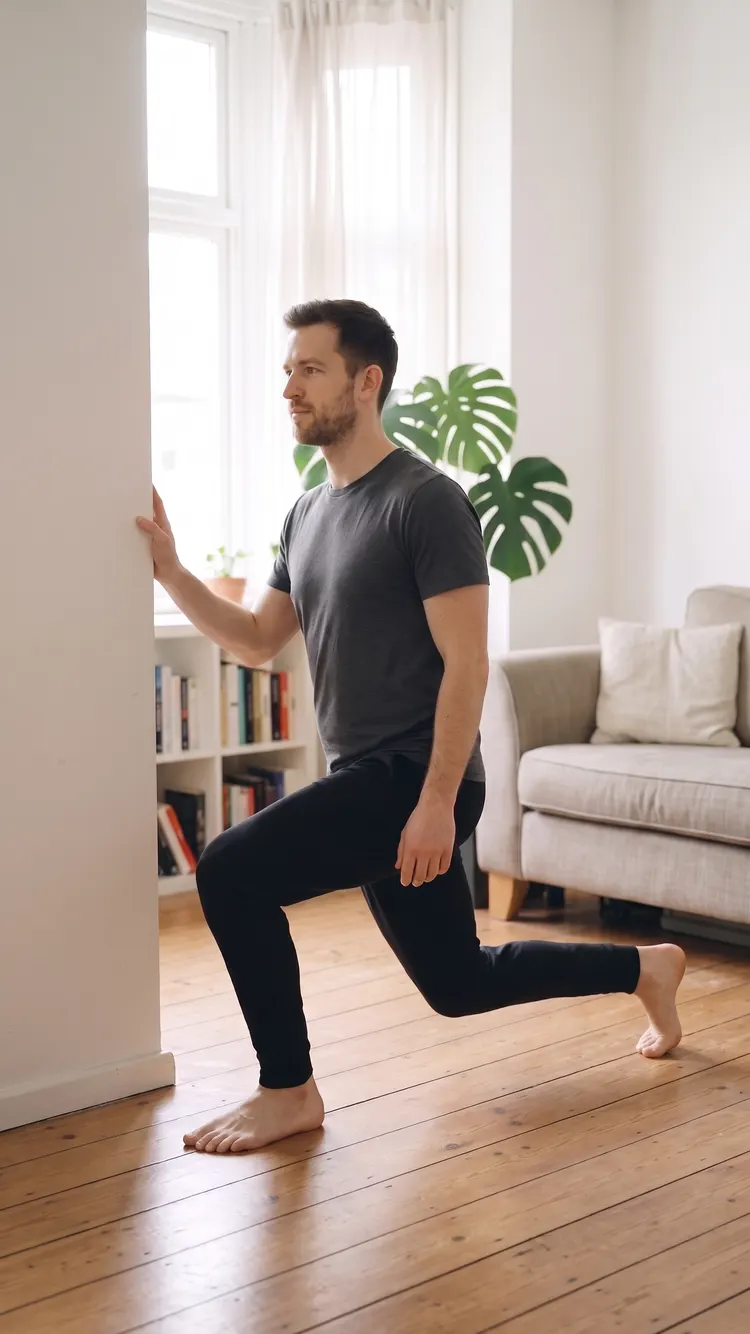
A staggered stance, back knee lowering a little. Keep a wall or chair within reach.
- Stand beside a wall or behind a sturdy chair, one hand lightly on it for balance.
- Step one foot back about a long stride, so you stand with one foot in front and one behind, both pointing forward. Your back heel is lifted.
- Breathe in and bend both knees, lowering your back knee a little toward the floor.
- Keep your chest tall and your front knee over your front foot.
- Breathe out and press through your front foot to rise. Do 4, then switch sides.
EasierLower only a few inches, keep a hand on the wall, or use the box squat.
Take care
- Knees: lower only as far as is comfortable. Your back knee should not bang the floor.
- Balance: keep your hand on the wall or chair and take a wider stance if you wobble.
- Hips: shorten your stride if your front hip feels pinched.
Wall sit
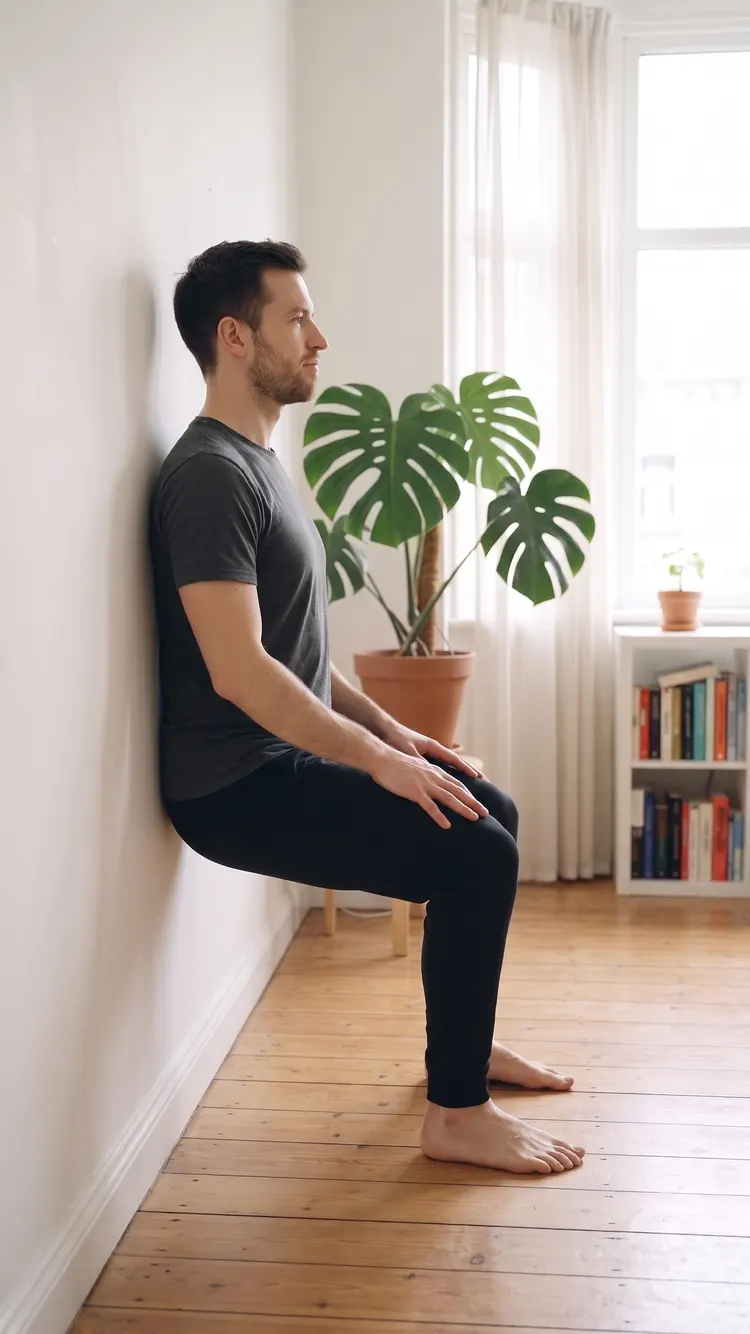
Back flat against the wall, knees bent, as if on a chair that is not there. Breathe throughout.
- Stand with your back flat on a wall, feet about a foot and a half in front of you, shoulder-width apart.
- Slide down the wall slowly until your knees are bent. Stop no deeper than chair height.
- Keep your whole back against the wall and your knees over your ankles. Rest your hands on your thighs or by your sides.
- Breathe slowly and hold for 15 to 20 seconds.
- Press through your feet and slide back up. Rest for a moment.
EasierSlide down only a little, or hold for 10 seconds.
Take care
- Knees: stay at chair height or higher. If your knees ache, slide up a little.
- Back: keep your back flat on the wall.
- Hips: stand up slowly when you finish.
A leg day that fits
- Two days a week, with a day between.
- Do one or two of the four moves, not all, until you know how you feel.
- Slow the way down before you add reps.
Build strength with a 28-day calisthenics plan
Short daily sessions at home, a step harder as you get stronger.
What the guidelines say
Activities that strengthen muscles: at least 2 days a week.
Too much? Be as active as your abilities and conditions allow.
Any amount of activity is better than none, and all activity counts.
World Health Organization, Physical activity, fact sheet
Stop if anything hurts, or if you feel dizzy, short of breath or chest pressure.
General information, not medical advice.