Single leg box squat: how to do it
A harder squat to a chair on one leg. You sit down slowly on one foot and stand, using the other foot lightly if you need it. Works: legs, hips and balance.
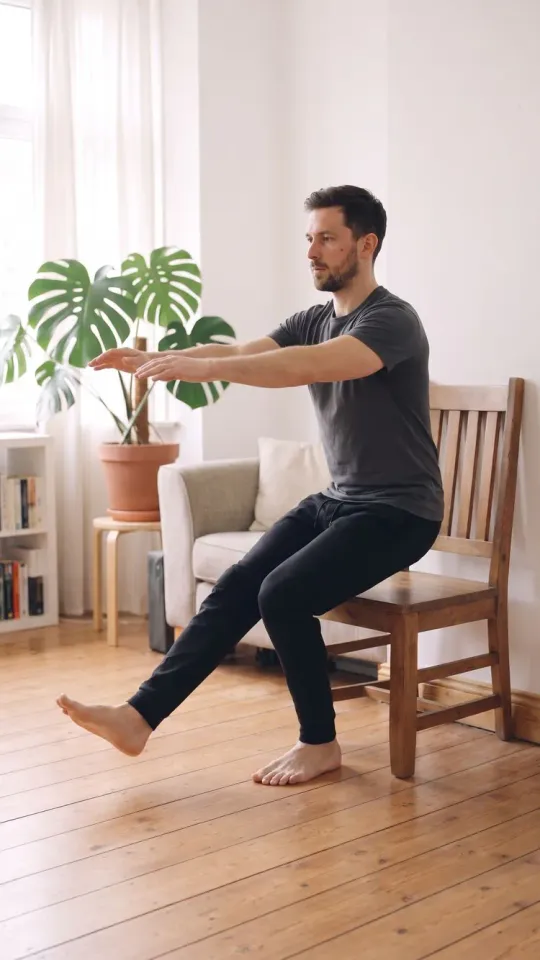
How to do it
- Set a sturdy chair with no wheels, its back against a wall. Put the chair beside a counter, or in a corner, so a hand can reach a support.
- Stand in front of the chair on your right foot, with your left foot just off the floor in front of you.
- Breathe in and send your hips back, lowering slowly to the seat over 3 counts.
- Touch the seat, then breathe out and press through your standing foot to rise. Let the other foot touch down lightly to help if you need it.
- Do 3, then switch legs.
As you go
- Keep your standing knee in line with your toes.
- Breathe in as you lower, breathe out as you stand. Never hold your breath.
- Use the help foot only as much as you need.
What it works
- Works
- legs, hips and balance
- Where you feel it
- In the front of the thigh and the seat of your standing leg, and through its ankle as it keeps you balanced.
- Position
- Standing, with a hand on a support
- Have nearby
- a sturdy chair, a wall
- Effort
- Harder
An easier and a harder version
Keep the other foot lightly on the floor the whole time, or do the two-leg box squat.
Use less help from the other foot. Keep the reps at 3 to 5 each side.
Take care
- Balance: this is a balance challenge. Keep a hand near a wall or counter and take your time.
- Knees: go only as deep as is comfortable. A higher seat is a good choice.
- Hips: if your hip pinches at the bottom, use a higher seat or both feet.
Single leg box squat: common mistakes
- Dropping onto the seat. Lower slowly and only just touch the seat.
- Standing knee caving in. Keep your knee in line with your toes, all the way down and up.
- Refusing the help foot. Let the other foot touch down lightly whenever you need it. Less help comes with time.
Single leg box squat: who it suits
A man for whom the box squat on two feet has become easy. It is a balance challenge too, so the calisthenics plan keeps it for its second round.
Kinder on your joints
For knees, use a higher seat and go only as deep as is comfortable. If your hip pinches at the bottom, use both feet. Keep a hand near a wall or counter.
Fit it into your day
On your desk chair, before you sit down to work.
Where it is in the plans
In our calisthenics plan, after its first 28 days: 2 of the next 28 days, first on day 16, One leg at a time.
| Plan | Days | First time | How much, that day |
|---|---|---|---|
| Calisthenics plan, round 2 | 2 of 28 days: 16 and 23 | Day 16, week 3: One leg at a time | 2 rounds: about 2 each side in a 65 s slot, 15 s rest |
| Week | Day | How much | The plan's note |
|---|---|---|---|
| 3 | 16 | 2 rounds: about 2 each side in a 65 s slot, 15 s rest | One foot, slow to the chair. Other foot helps as needed. |
| 4 | 23 | 2 rounds: about 3 each side in a 65 s slot, 15 s rest | One foot, slow to the chair. Other foot helps as needed. |
Single leg box squat: how much should you do?
Start with 3 each side. After its first 28 days, our calisthenics plan gives it 2 rounds: about 2 each side in a 65 s slot, 15 s rest on day 16 of the next round.
Single leg box squat: after day 28 of our calisthenics plan
Short daily sessions at home, a step harder as you get stronger.
What the guidelines say
Activities that strengthen muscles: at least 2 days a week.
Breathe out on the effort and in as you relax. Don't hold your breath.
National Institute on Aging (NIH), Three Types of Exercise
Stop if anything hurts, or if you feel dizzy, short of breath or chest pressure.