Open book: how to do it
A gentle twist lying on your side. You open your top arm across your body like the cover of a book. Works: upper back, chest and shoulders.
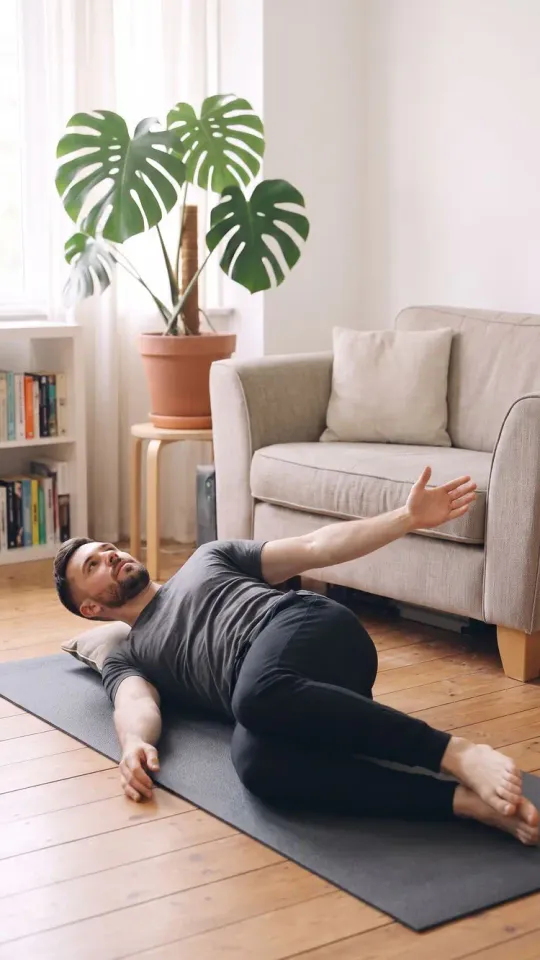
How to do it
- Lie on your side on a mat or folded towel on a non-slip floor, with a small pillow under your head if you like. Bend your knees toward your chest and stack them.
- Reach both arms straight out in front of you, palms together.
- Breathe in. Breathe out and slowly open your top arm up and across, letting your chest turn toward the ceiling.
- Let your eyes follow your hand if that feels easy on your neck. Keep your knees stacked.
- Breathe in and bring your arm back. Do 3 slow rounds, then switch sides.
As you go
- Keep your knees stacked and still, so the turn comes from your upper back.
- Breathe out as you open. Keep breathing.
- Turn only as far as feels easy. Never bounce.
What it works
- Works
- upper back, chest and shoulders
- Where you feel it
- Through the middle of your back and across your chest as the top arm opens.
- Position
- On the floor
- Have nearby
- a mat
- Effort
- Gentle
An easier and a harder version
Open your arm only halfway, or keep your head resting on the pillow and look straight up.
Pause for a full breath when your arm is open.
Take care
- Back: if your lower back aches, make the turn smaller.
- Shoulders: stop short of any pinch, and let your arm rest on a pillow if it does not reach the floor.
- Neck: keep your head resting. Never pull on your head.
Open book: common mistakes
- Knees sliding apart. Keep your knees stacked and still, so the turn comes from your upper back.
- Forcing the arm to the floor. Open only as far as feels easy. The arm can rest on a pillow.
- Twisting fast. Breathe out as you open, and take a full breath to come back.
Open book: who it suits
A stiff upper back from desk days or carrying heavy things. It is the calisthenics plan's upper back stretch, on many of its days.
Kinder on your joints
For your back, make the turn smaller. For your neck, keep your head on a pillow and look straight up. Stop short of any pinch in the shoulder.
Fit it into your day
On the bedroom floor before sleep, a slow few each side.
Where it is in the plans
In our calisthenics plan: 11 of 28 days, first on day 4, Floor mobility.
| Plan | Days | First time | How much, that day |
|---|---|---|---|
| Calisthenics plan | 11 of 28 days: 4 to 5, 7, 11 to 12, 14, 18 to 19, 21 and 25 to 26 | Day 4, week 1: Floor mobility | 50 s each side |
| Calisthenics plan, round 2 | 9 of 28 days: 4 to 5, 7, 12, 14, 18 to 19 and 25 to 26 | Day 4, week 1: Stand, then floor | 50 s each side |
| Week | Day | How much | The plan's note |
|---|---|---|---|
| 1 | 4 | 50 s each side | On your side, knees stacked. Open the top arm slowly. |
| 2 | 11 | 50 s each side | On your side, knees stacked. Open the top arm slowly. |
| 3 | 18 | 50 s each side | On your side, knees stacked. Open the top arm slowly. |
| 4 | 25 | 50 s each side | On your side, knees stacked. Open the top arm slowly. |
Open book: how much should you do?
Start with 3 each side. Day 4 of our calisthenics plan gives it 50 s each side.
Open book: day 4 of a 28-day calisthenics plan
Short daily sessions at home, a step harder as you get stronger.
What the guidelines say
Short bouts count: the 2018 guidelines dropped the old 10-minute minimum.
U.S. Department of Health and Human Services, Top 10 Things to Know About the Physical Activity Guidelines
Any amount of activity is better than none, and all activity counts.
World Health Organization, Physical activity, fact sheet
Stop if anything hurts, or if you feel dizzy, short of breath or chest pressure.