One-arm doorframe row: how to do it
The doorframe row with one hand at a time. You hold the edge of a solid doorframe, lean back a little, and pull your chest toward it with one arm. Works: upper back, arms and posture.
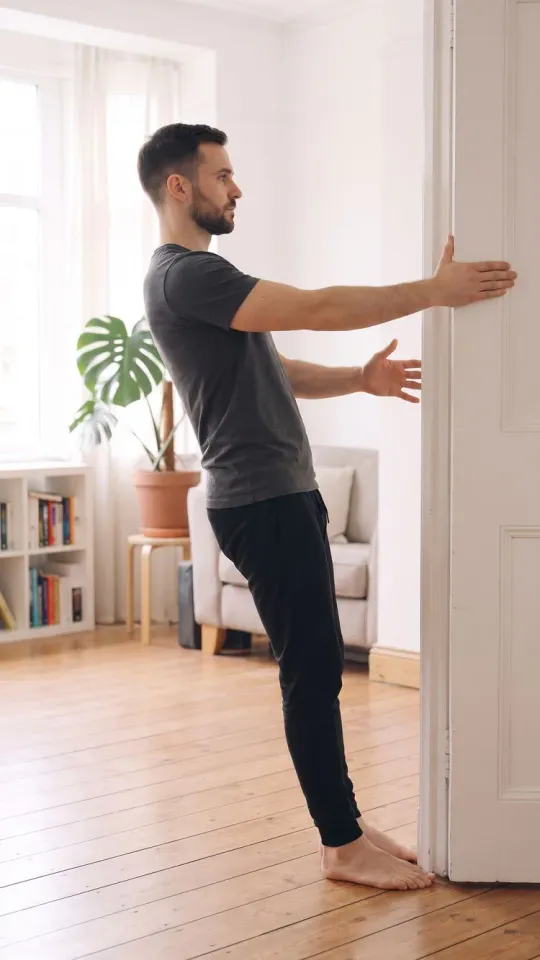
How to do it
- Pick a doorway with a solid frame, one you already know holds your weight, and no door that can swing. Wear non-slip shoes.
- Face the edge of the frame with your feet close to it. Hold the frame itself with one hand at chest height, arm straight.
- Keep your free hand near the frame, ready to grab it. Lean back a little, body in one straight line.
- Breathe out and bend your elbow, pulling your chest toward the frame. Breathe in and straighten your arm slowly.
- Do 3 to 4 reps, then switch hands.
As you go
- Keep your hips and shoulders facing the frame: no twisting.
- Breathe out as you pull and in as you lower. Keep breathing.
- Lean back only as far as feels steady.
What it works
- Works
- upper back, arms and posture
- Where you feel it
- In your back on the working side, between the shoulder blade and the spine, and in that arm.
- Position
- Standing
- Have nearby
- a door frame
- Effort
- Harder
An easier and a harder version
Do the doorframe row with both hands, or move your feet a little farther back so you stand more upright and lean less.
Lower for 3 counts, or pause for 1 count at the top. Keep your feet close to the frame and do not lean farther. If you have a heavy solid table and a clear floor, the table row is the next rung.
Take care
- Setup: hold the frame itself, never the door, a handle or decorative trim. Use only a solid frame you already know holds your weight. A look or a gentle tug is not proof. No setup you're sure of? Skip this one today; the rest of the session still counts.
- Shoulders: pull gently and stop short of any pinch.
- Balance: lean back only a little, and keep your free hand near the frame, ready to grab it.
- Back: keep your body in one line. Do not twist or arch your lower back.
One-arm doorframe row: common mistakes
- Twisting toward the frame. Keep your hips and shoulders square to the frame as you pull.
- Leaning far back to make it harder. Lean back only a little. To make it harder, lower more slowly instead.
- Holding the door or its trim. Hold the frame itself, a solid one you already know holds your weight.
One-arm doorframe row: who it suits
A man for whom the doorframe row with both hands has become easy. One hand at a time gives each side the whole pull, in the calisthenics plan's second round.
Kinder on your joints
For shoulders, pull gently and stop short of any pinch. Stand more upright to lean less. Keep your free hand near the frame, ready to grab it.
Fit it into your day
Between calls on a day you work from home.
Where it is in the plans
In our calisthenics plan, after its first 28 days: 3 of the next 28 days, first on day 12, One-arm row.
| Plan | Days | First time | How much, that day |
|---|---|---|---|
| Calisthenics plan, round 2 | 3 of 28 days: 12, 19 and 26 | Day 12, week 2: One-arm row | 2 rounds: about 3 each side in a 60 s slot, 15 s rest |
| Week | Day | How much | The plan's note |
|---|---|---|---|
| 2 | 12 | 2 rounds: about 3 each side in a 60 s slot, 15 s rest | One hand on the frame, lean back, pull in. Then switch. |
| 3 | 19 | 2 rounds: about 4 each side in a 65 s slot, 15 s rest | One hand on the frame, lean back, pull in. Then switch. |
| 4 | 26 | 2 rounds: about 4 each side in a 65 s slot, 15 s rest | One hand on the frame, lean back, pull in. Then switch. |
One-arm doorframe row: how much should you do?
Start with 4 each side. After its first 28 days, our calisthenics plan gives it 2 rounds: about 3 each side in a 60 s slot, 15 s rest on day 12 of the next round.
One-arm doorframe row: after day 28 of our calisthenics plan
Short daily sessions at home, a step harder as you get stronger.
What the guidelines say
Activities that strengthen muscles: at least 2 days a week.
Breathe out on the effort and in as you relax. Don't hold your breath.
National Institute on Aging (NIH), Three Types of Exercise
Stop if anything hurts, or if you feel dizzy, short of breath or chest pressure.