Decline push-up: how to do it
A push-up with your feet up on a bottom stair. Raising your feet puts more of your weight on your hands and shoulders. Works: chest, shoulders and arms.
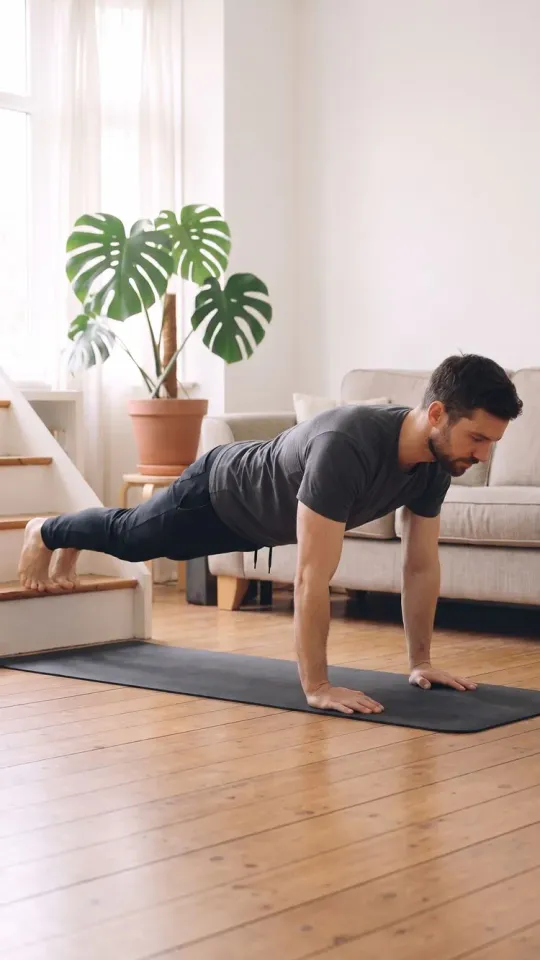
How to do it
- Choose a fixed bottom stair, not a stool or box. Use a comfortable carpet or firm clear floor next to it, with a folded towel if you like.
- Get down to the floor slowly onto your hands and knees, then place your toes on the bottom stair.
- Place your hands under your shoulders so your body makes a straight line from head to heels.
- Breathe in and bend your elbows, bringing your chest toward the floor. Breathe out and press back up.
- Do 3 to 5 push-ups, then lower your knees to the floor and rest.
As you go
- Keep your body in one straight line, no sagging hips.
- Breathe in as you lower and out as you press. Keep breathing.
- Use only the bottom stair and keep your feet steady on it.
What it works
- Works
- chest, shoulders and arms
- Where you feel it
- In your upper chest and the fronts of your shoulders, more than in a regular push-up.
- Position
- On the floor
- Have nearby
- a towel, a step
- Effort
- Harder
An easier and a harder version
Put your feet on the floor and do a regular push-up, or do a knee push-up. A lower surface for your hands is harder, a higher one is easier.
Lower for 3 counts, or do 6 to 8 reps. Keep to the bottom stair.
Take care
- Dizziness: if you take blood pressure medicine or feel dizzy with your head down, do a regular or incline push-up instead, and come up slowly.
- Wrists: make soft fists on the floor, or choose an incline push-up with hands on a counter.
- Shoulders: use a smaller bend and stop short of any pinch.
- Back: if your lower back sags, put your feet back on the floor.
- Balance: use only the bottom stair, with shoes that will not slide.
Decline push-up: common mistakes
- Feet on a stool or a box. Use only a fixed bottom stair, which can't slide or tip.
- Hips sagging. Squeeze your seat and belly so your body stays one line from the stair to your head.
- Jumping straight up after the set. Rest on your knees after the last rep, then stand up slowly.
Decline push-up: who it suits
A strong, steady push-up that is ready to be harder without weights. The calisthenics plan keeps it for its second round.
Kinder on your joints
For shoulders, use a smaller bend. For wrists, make soft fists. If you feel dizzy with your head low, do a regular or incline push-up instead.
Fit it into your day
At the bottom of the stairs, before you head up to bed.
Where it is in the plans
In our calisthenics plan, after its first 28 days: 2 of the next 28 days, first on day 22, Decline push-ups.
The plan's note that day: Toes on the bottom stair only. One straight line.
| Plan | Days | First time | How much, that day |
|---|---|---|---|
| Calisthenics plan, round 2 | 2 of 28 days: 22 and 28 | Day 22, week 4: Decline push-ups | 2 rounds: about 5 reps in a 65 s slot, 15 s rest |
Decline push-up: how much should you do?
Start with 5 reps. After its first 28 days, our calisthenics plan gives it 2 rounds: about 5 reps in a 65 s slot, 15 s rest on day 22 of the next round.
Decline push-up: after day 28 of our calisthenics plan
Short daily sessions at home, a step harder as you get stronger.
What the guidelines say
Activities that strengthen muscles: at least 2 days a week.
Breathe out on the effort and in as you relax. Don't hold your breath.
National Institute on Aging (NIH), Three Types of Exercise
Stop if anything hurts, or if you feel dizzy, short of breath or chest pressure.