Incline push-up: how to do it
A push-up with your hands on a sturdy counter or table edge. The higher your hands, the lighter the load. Works: chest, arms and shoulders.
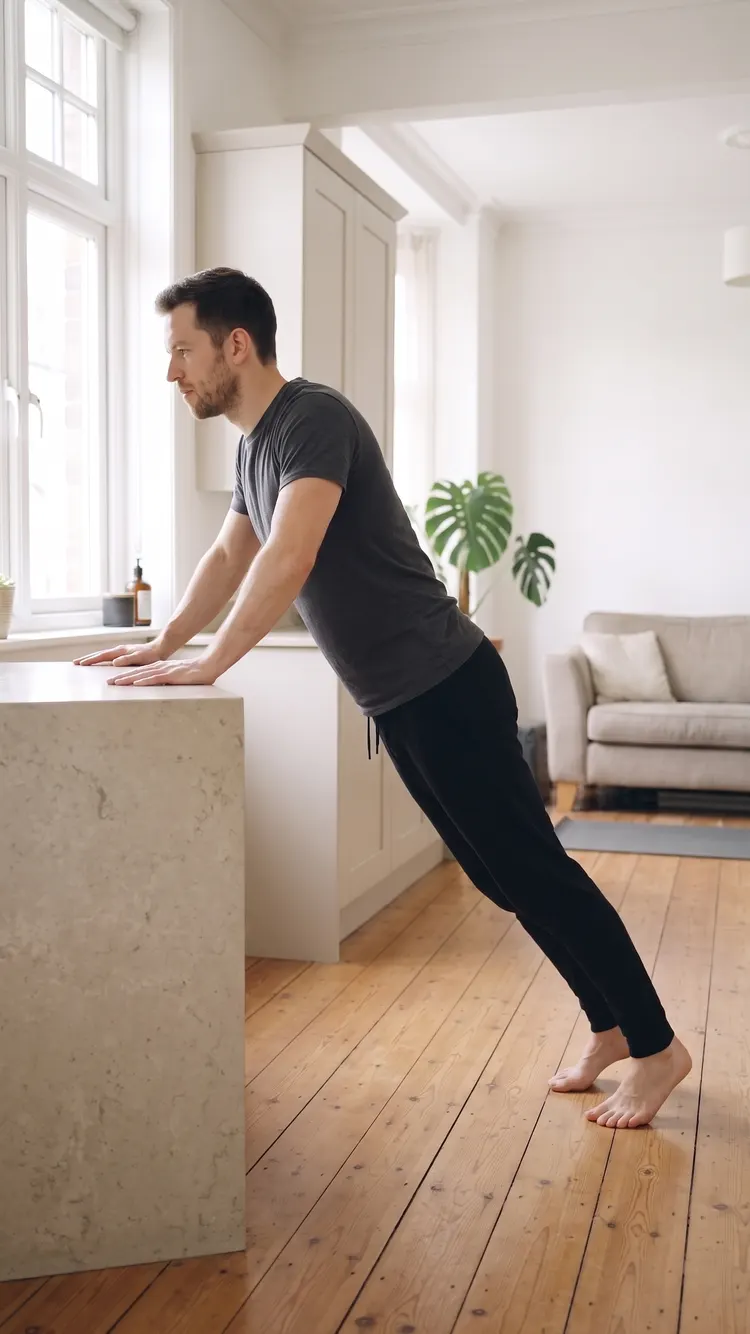
How to do it
- Choose a heavy counter or table that will not slide, and wear non-slip shoes.
- Place your hands on the edge, a little wider than your shoulders. Walk your feet back until your body makes one straight slope from head to heels.
- Breathe in and bend your elbows, bringing your chest toward the edge.
- Breathe out and press back until your arms are straight but not locked.
- Do 6 to 8 push-ups, then walk your feet in and stand tall.
As you go
- Keep your body in one straight line, no sagging hips.
- Breathe in as you lower and out as you press. Keep breathing.
- Move slowly, with no bounce.
What it works
- Works
- chest, arms and shoulders
- Position
- Standing, with a hand on a support
- Have nearby
- a counter
- Effort
- Moderate
An easier and a harder version
Walk your feet in closer so you lean less, or do wall push-ups.
Do 10 to 12 reps, or lower for 3 counts. Use a lower sturdy surface only when this feels easy.
Take care
- Wrists: if flat hands ache, make soft fists on the counter, or choose a wall push-up.
- Shoulders: use a smaller bend and stop short of any pinch.
- Balance: keep the counter steady and your shoes non-slip.
Where it is in the plans
In our calisthenics plan: the Chest finisher, a 4-minute block added after a workout when his answers ask for a longer session.
The plan's note that day: Hands on a counter. Body in one straight line.
| Plan | Days | First time | How much, that day |
|---|---|---|---|
| Calisthenics plan | When his answers ask for it | Chest finisher, 4 minutes | 1 round: about 8 reps in a 55 s slot, 20 s rest |
In the plan, this move plays as a looping video with a spoken cue.
Incline push-up: in the Chest finisher of a 28-day calisthenics plan
Short daily sessions at home, a step harder as you get stronger.
What the guidelines say
Activities that strengthen muscles: at least 2 days a week.
Stop if anything hurts, or if you feel dizzy, short of breath or chest pressure.
General information, not medical advice.