Does chair yoga work for seniors?
For strength and everyday movement, the research leans yes, with limits. A 2021 review of chair-based exercise in adults 50 and over (25 studies, 1,388 people, 7 with chair yoga) found better arm and leg function. Chair yoga's own trials are mixed: one found a faster walking speed during the program and no change in balance, and a larger one no change in quality of life.
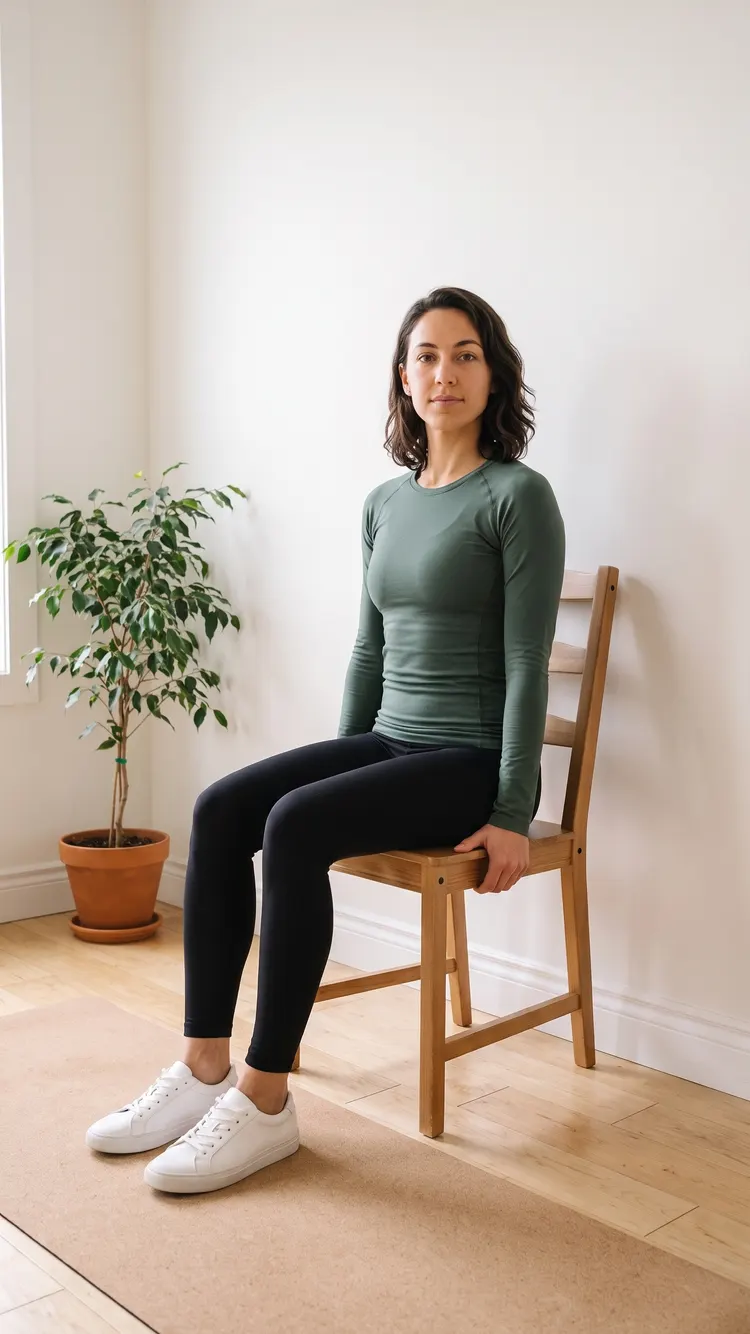
What the sources say
Chair-based exercise in adults 50 and over, 25 studies and 1,388 participants: better handgrip strength, 30-second arm curl and 30-second chair stand. Seven of the studies included chair yoga; the rest were other chair-based exercise.
International Journal of Environmental Research and Public Health, 2021, The Effect of Chair-Based Exercise on Physical Function in Older Adults
Chair yoga in 131 older adults with lower-limb osteoarthritis, 45 minutes twice a week for 8 weeks, against health education: pain interference was lower through 3 months; pain, walking speed and fatigue improved during the program but not after it; balance did not change.
Park et al., Journal of the American Geriatrics Society, 2017, A Pilot Randomized Controlled Trial of the Effects of Chair Yoga
A 12-week chair yoga program in 454 adults 65 and over with long-term conditions did not improve quality of life against usual care. It was safe, and acceptable to most participants.
Tew et al., NIHR Open Research, 2024, Effectiveness and cost-effectiveness of offering a chair-based yoga programme
Yoga of any kind, 22 trials in older adults: against no exercise, better balance, lower-limb strength and lower-body flexibility, with no significant difference in walking speed.
Sivaramakrishnan et al., International Journal of Behavioral Nutrition and Physical Activity, 2019, The effects of yoga compared to active and inactive controls
In a 2014 review, 11 of 15 studies (688 participants) of yoga and balance in healthy people found improvement in at least one measure of balance.
National Center for Complementary and Integrative Health (NIH), Yoga: Effectiveness and Safety
The CDC's examples of moderate activity include walking briskly and active forms of yoga, such as Vinyasa or power yoga.
The numbers, worked out
| Week | Sessions | A session | Minutes a week |
|---|---|---|---|
| Week 1: Settle | 6 | 10 min | 60 |
| Week 2: Lengthen | 6 | 12 to 14 min | 78 |
| Week 3: Strengthen | 6 | 15 to 17 min | 96 |
| Week 4: Flow | 7 | 18 to 20 min | 132 |
From the plan's own days, rest days left out. For scale, the 8-week trial above ran 90 minutes a week, 2 sessions of 45.
What to do with it
- Use chair yoga for what the studies measured: arm and leg strength and getting up from a chair.
- If you can, add a walk as well: walking briskly is on the CDC's list.
- Use a sturdy chair without wheels, and move up as the sessions get longer.
Try chair yoga at home with a 28-day chair plan
Short daily sessions at home, a step harder as you get stronger.
Stop if anything hurts, or if you feel dizzy, short of breath or chest pressure.
General information, not medical advice.