Skater step: how to do it
A side-to-side move like a speed skater. You step to the side, reach across, and step back. The step is a no-hop version. Works: whole body, legs and balance.
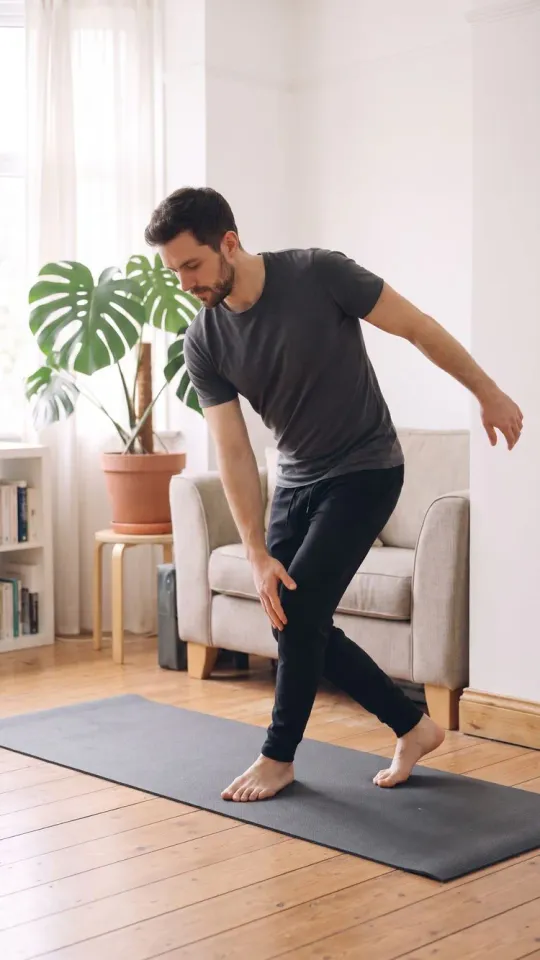
How to do it
- Stand tall with your feet hip-width apart. Keep the space around you clear.
- Step your right foot out to the right and shift your weight onto it.
- Let your left foot swing behind you, toes touching the floor, and reach your left hand toward your right foot.
- Push off your right foot and step to the left.
- Switch sides in a steady rhythm for 30 seconds.
As you go
- Step, do not hop. One foot is always on the floor.
- Breathe steadily the whole time. Keep breathing.
- Keep your front knee over your toes and bend only a little.
What it works
- Works
- whole body, legs and balance
- Where you feel it
- On the outsides of your hips and in the thigh of the landing leg, with your breath picking up.
- Position
- Standing
- Have nearby
- Nothing
- Effort
- Moderate
An easier and a harder version
Take smaller steps with less reach, with a hand on a wall.
Add a small hop from side to side, landing softly on one foot. The hop adds impact, so skip it if it bothers you.
Take care
- Balance: keep a counter or wall within reach and take smaller steps.
- Knees: keep your front knee over your toes and your steps short.
- Impact: only the small hop version has impact. Keep the plain step if in doubt.
Skater step: common mistakes
- Hopping before you are ready. Step, don't hop: one foot always stays on the floor.
- Landing knee drifting inward. Keep the landing knee over your toes and bend it only a little.
- Reaching so far you lose your balance. Reach only as far as you stay steady, with a hand near the wall if you need it.
Skater step: who it suits
A man who wants his heart rate up without jumping. It works the legs side to side, in the calisthenics plan's second round.
Kinder on your joints
For knees, keep the steps short and the bend small, and leave out the hop. Take smaller steps with a hand on the wall.
Fit it into your day
At halftime of a game on TV.
Where it is in the plans
In our calisthenics plan, after its first 28 days: 3 of the next 28 days, first on day 10, Skater circuit.
| Plan | Days | First time | How much, that day |
|---|---|---|---|
| Calisthenics plan, round 2 | 3 of 28 days: 10, 17 and 24 | Day 10, week 2: Skater circuit | 2 rounds: about 35 s in a 60 s slot, 15 s rest |
| Week | Day | How much | The plan's note |
|---|---|---|---|
| 2 | 10 | 2 rounds: about 35 s in a 60 s slot, 15 s rest | Step to the side and reach across. No hop. |
| 3 | 17 | 2 rounds: about 40 s in a 65 s slot, 15 s rest | Step to the side and reach across. No hop. |
| 4 | 24 | 2 rounds: about 40 s in a 65 s slot, 15 s rest | Step to the side and reach across. No hop. |
Skater step: how much should you do?
Start with 30 s. After its first 28 days, our calisthenics plan gives it 2 rounds: about 35 s in a 60 s slot, 15 s rest on day 10 of the next round.
Skater step: after day 28 of our calisthenics plan
Short daily sessions at home, a step harder as you get stronger.
What the guidelines say
Short bouts count: the 2018 guidelines dropped the old 10-minute minimum.
U.S. Department of Health and Human Services, Top 10 Things to Know About the Physical Activity Guidelines
Any amount of activity is better than none, and all activity counts.
World Health Organization, Physical activity, fact sheet
Stop if anything hurts, or if you feel dizzy, short of breath or chest pressure.